


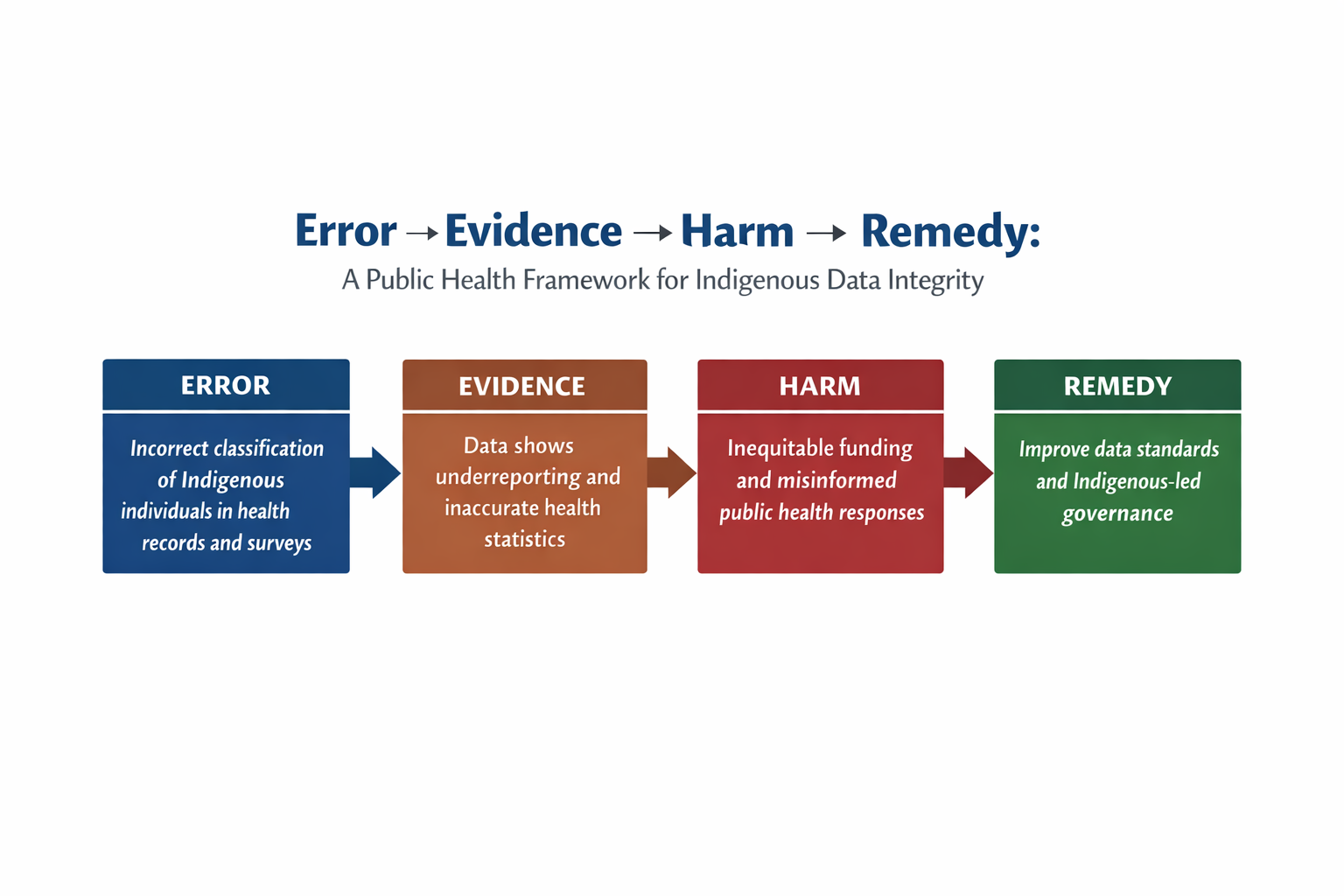
Error → Evidence → Harm → Remedy: A Public Health Framework for Indigenous Data Integrity
Accurate demographic data is foundational to effective public health surveillance, research, and policy.
For Indigenous populations, persistent misclassification in health data systems creates structural barriers
that affect disease tracking, funding allocation, and clinical decision-making.
The Indigenous Data Integrity Collaborative (IDIC) applies a clear, public health–aligned framework to
identify and correct these issues. This framework—Error → Evidence → Harm → Remedy—supports
transparent analysis and actionable solutions.
Visual Framework Overview
Error
Indigenous individuals are incorrectly classified or excluded in health records, surveys,
and administrative datasets due to outdated categories, inconsistent standards, or system limitations.
Evidence
Epidemiological data reveal discrepancies such as underreported disease rates, distorted mortality
statistics, and incomplete population counts affecting Indigenous communities.
Harm
These data errors contribute to inequitable funding, misinformed public health responses,
delayed interventions, and increased risk of incorrect or delayed diagnosis.
Remedy
Solutions include improved classification standards, Indigenous-led data governance,
community-informed data collection, and accountability mechanisms across health systems.
Why This Framework Matters in Public Health
Public health decisions are only as effective as the data that informs them. When Indigenous populations
are misclassified, entire communities may be excluded from surveillance metrics, resulting in gaps
across prevention, response, and long-term planning.
This framework allows public health practitioners, researchers, and policymakers to move beyond
identifying disparities toward implementing measurable, ethical, and sustainable remedies.
How IDIC Applies This Framework
- Supporting accurate Indigenous identification in public health data systems
- Promoting Indigenous data sovereignty and governance principles
- Providing guidance for ethical data collection and reporting
- Advocating for accountability in health research and policy
By aligning data practices with lived realities and community knowledge, IDIC works to ensure that
public health systems reflect — rather than obscure — Indigenous health experiences.
Learn More:
Explore how accurate Indigenous data strengthens public health decision-making on our
Public Health Resources page
.
Leave a Reply